
Author: Tejovathi. R
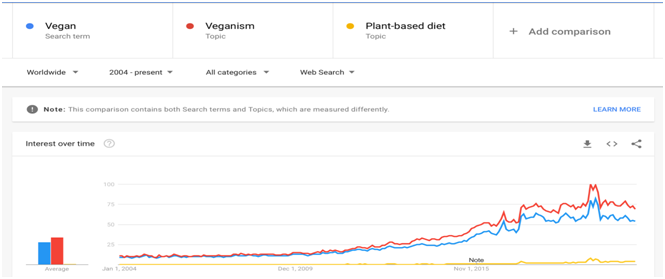
Food-based trends have always captured the interest of people and had possibly reached a peak during the almost year-long quarantine. Thanks to the folks of the internet, people were introduced to various food-based trends during the time. Be it the Focaccia Bread Art, the Dalgona Coffee, or the Sourdough Starter, people were enthusiastic about incorporating these dishes in their diet. However, like any other trend, these were eventually forgotten by most, with new trends claiming the center of attention. But, a trend that has created a significant impact on people comes with the adoption of a plant-based lifestyle and diet. According to Chef’s Pencil, a food-media outlet, veganism is here to stay. The outlet states that the popularity of veganism has reached an all-time high during the pandemic, and has surpassed the prior all-time high registered in 2019. Veganism is now twice as common as it was only five years ago, and it shows no signs of slowing down, according to the outlet.
With such a huge influence on the lifestyle of several people, it is important to understand what exactly veganism, and a plant-based diet is. According to The Vegan Society, “Veganism is a philosophy and way of living which seeks to exclude—as far as is possible and practicable—all forms of exploitation of, and cruelty to, animals for food, clothing or any other purpose; and by extension, promotes the development and use of animal-free alternatives for the benefit of animals, humans and the environment. In dietary terms, it denotes the practice of dispensing with all products derived wholly or partly from animals”.
So not only does a vegan exclude animal-based products from their diet, they do not incorporate any animal product at all. Be it a leather jacket, or a velvet suit, vegans do not endorse the use of any animal-based materials at all, for ethical reasons. With a plant-based diet however, according to Piedmont, you can decide whether or not you want to consume animal products, and the focus is on eating mostly foods that come from plant sources. Plant-based diets also emphasize eating whole foods, meaning the food has undergone little – if any – processing and is as close to its natural state as possible.
So how did it all start then? Donald Watson, a British woodworker had primarily come up with the term ‘vegan’. He had coined this term in an effort to be able to distinguish between dairy and non-dairy-consuming vegetarians, and had also effectively formed the Vegan Society along with a bunch of others identifying as vegan. Watson used the fact that about 40% of Britain’s dairy cows were found to be affected by Tuberculosis the previous year to his advantage, and had claimed that adopting a vegan lifestyle would effectively protect them. In 1951, the Vegan Society had updated its definition to “exclude all forms of animal exploitation”. Almost six decades later, in 2005, there were about 250,000 self-identifying vegans in Britain and 2 million in the U.S. As of now, there are about 79 million people who identify as vegans worldwide.
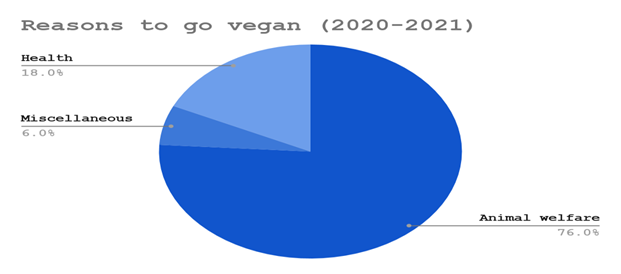
The reason behind why people opt to go the vegan way varies from one to another. According to a survey by Vegan Food & Living in 2020, it was found that about 76% of the respondents had chosen to go vegan for animal welfare, while about 18% were doing it for their health. However, for those who classed themselves as plant-based, when asked for the main reason they decided to follow that diet, 43% said animal welfare, but equally 43% said their motivation was health. The health benefits to going vegan, according to verywellfit, is that it becomes much easier to load up on healthy whole grains, legumes, fruits, and vegetables that many people on regular diets lack. Studies comparing different types of diets have found that vegan eating ranks highest for nutritional quality. A vegan diet is generally high in fiber, vitamin C, magnesium, iron, and folate and lower in calories and saturated fats.
However, there are a few defects that come along with vegan and plant based diet according to critics and health experts. One of the main concerns is the possible deficiency of nutrients in a vegan or plant based diet. Researchers have found that vegan diets are generally lacking in calcium, required for bone formation, muscle contraction, and other essential functions. Furthermore, these diets also generally lack in Vitamin B-12, as it is found in foods mostly of animal origin. Although some seaweed, mushrooms, and fermented foods can be a useful source of this essential B-complex vitamin, researchers have found that supplementation may be needed for people who follow a vegetarian or vegan diet. A vegan diet is also deficient in two omega-3 fatty acids called eicosapentaenoic acid and docosahexaenoic acid that your body needs for a healthy heart and eyes and brain function.
Furthermore, there is a widespread perception that leading a vegan or plant-based lifestyle could get quite expensive. While processed vegan products tend to be more expensive than their dairy or meat equivalent, it is not particularly an expensive diet to follow, according to the Vegan Society. Although a few years ago these vegan products were likely to have cost more, the situation now differs, with the products readily available in health shops and specialist stores. The situation has since changed significantly, with big-name retailers offering numerous vegan items, including cheaper, own-brand ranges. Despite this transformation, veganism’s history of being a more niche diet has likely led to the continuing belief that it will still cost a little bit extra to follow.
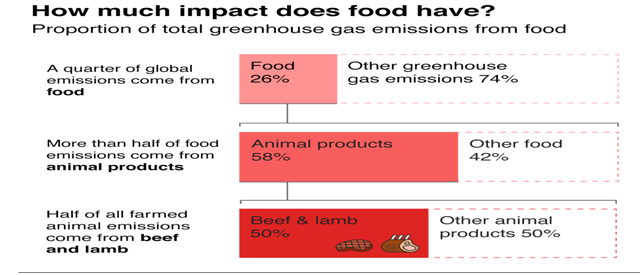
Researcher and author Joseph Poore in conversation with Independant, had revealed that a vegan diet is probably one of the biggest ways to reduce a person’s impact on planet Earth. “It is far bigger than cutting down on your flights or buying an electric car,” he explained, which would only reduce greenhouse gas emissions. “Avoiding consumption of animal products delivers far better environmental benefits than trying to purchase sustainable meat and dairy,” he added.
According to a report by the United Nations shifting to a plant-based diet could save the world from hunger, fuel poverty, and the worst impacts of climate change. “Impacts from agriculture are expected to increase substantially due to population growth increasing consumption of animal products.” says the UNEP report, keeping in mind the global population surges towards a prediction of 9.1 billion people by 2050. “Unlike fossil fuels, it is difficult to look for alternatives: people have to eat. A substantial reduction of impacts would only be possible with a substantial worldwide diet change, away from animal products.” explains the UNEP report.
Good ranking of https://topcasino-affiliateprograms.com/ casino and sports betting affiliate programs, Super affiliate programs only with us, review, rating
Good ranking of https://24online-casino-affiliate-programs.com/ casino and sports betting affiliate programs, Super affiliate programs only with us, review, rating
aviator
https://vitz.ru/forums/index.php?autocom=gallery&req=si&img=4806
https://vitz.ru/forums/index.php?autocom=gallery&req=si&img=4923
https://myteana.ru/forums/index.php?autocom=gallery&req=si&img=6850
https://myteana.ru/forums/index.php?autocom=gallery&req=si&img=6688
https://honda-fit.ru/forums/index.php?autocom=gallery&req=si&img=7121
https://myteana.ru/forums/index.php?autocom=gallery&req=si&img=6919
https://myteana.ru/forums/index.php?autocom=gallery&req=si&img=6763
MiyaGi & Andy Panda – Там Ревели Горы скачать песню бесплатно в mp3 и слушать онлайн https://shorturl.fm/9bdJG
http://toyota-porte.ru/forums/index.php?autocom=gallery&req=si&img=3347
Kenar – Фестиваль скачать бесплатно mp3 и слушать онлайн https://shorturl.fm/dZ5o5
TemiRiS – Месяц под луной скачать песню и слушать онлайн
https://allmp3.pro/3274-temiris-mesjac-pod-lunoj.html
Dead Blonde Feat. & Винтаж – Без Шансов скачать песню и слушать онлайн
https://allmp3.pro/3005-dead-blonde-feat-vintazh-bez-shansov.html
Looking for a betting site specifically for Brazil? Came across Realsbetbrazil. Anyone from Brazil using this site? What do you think? Good odds? Check it out here: realsbetbrazil
I don’t tend to spend money on these things, but 99ok88 grabbed my attention. This site is super easy to follow, so I understand what I am doing. Great start!